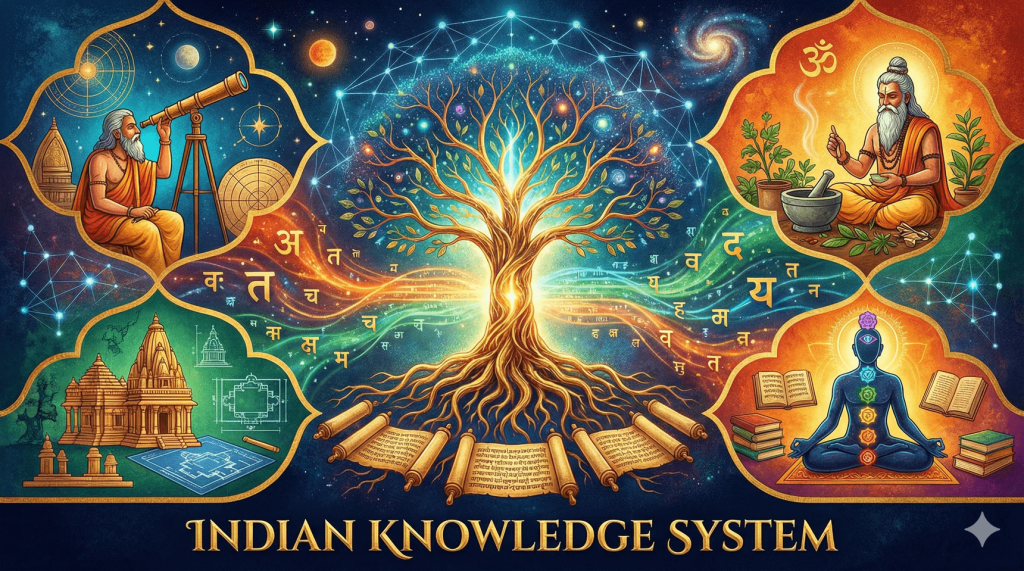

Indian Knowledge System (IKS), a comprehensive and interdisciplinary framework that treats various fields of study as an interconnected whole. Unlike fragmented modern educational models, this ancient approach integrates material success with spiritual development through foundational texts like the Vedas and their practical applications.

A historical breakthroughs in mathematics, medicine, and metallurgy that Indian scholars pioneered concepts like zero and calculus long before their Western counterparts. Additionally, the text details the six orthodox philosophies that provide the logical basis for these scientific pursuits. Today, this traditional wisdom is being revisited for its modern relevance in areas such as sustainable living, holistic health, and artificial intelligence. Ultimately, the system views the pursuit of knowledge as a way to align human life with the cosmic order.
The OG Influencers: Why Ancient India Was "Living Sustainably" While the Rest Were Still Beta Testing Civilization
Let’s be real: Modern education loves to compartmentalize. You do Math in one room, Art in another, and never shall the two meet. Meanwhile, the Indian Knowledge System (IKS) was the original "Full Stack Developer," realizing 3,000 years ago that everything—from your house’s front door to the planet Saturn—is connected.

Here’s a quick roast of modern history vs. what actually went down:
1. Math: We Didn’t Just "Invent" Zero, We Gave It a Job
While other cultures used zero as a glorified placeholder (literally just an empty space), Brahmagupta turned Shunya into a functional number with actual rules. And let’s talk about Baudhayana. He dropped the "Pythagorean" theorem centuries before Pythagoras was even born, mostly because we needed precise geometry to build ritual altars.
- The Kerala School was doing calculus and infinite series 200 years before European scholars. Newton and Leibniz were late to the party, but we let them have their moment.
2. Metallurgy: Built Different (Literally)
Have you noticed how your washing machine rusts after five years? Meanwhile, the Iron Pillar of Delhi has been standing outside for millennia, rain or shine, completely rust-free. Ancient India was extracting Zinc and making Wootz steel (later rebranded as Damascus steel by the West) while the rest of the world was still figuring out sharp sticks.
- Modern tech is planned obsolescence; Ancient tech was "buy it for life" (and the next 50 lives).
3. Vastu & Sthapatyaveda: The Original "Green Living"
Modern architects are suddenly obsessed with "sustainable living." That’s cute. Vastu Shastra has been aligning homes with nature and the Cosmic Order (Rita) since forever. It wasn't just about utility; it was about making sure your house didn't ruin your spiritual vibe.
- We didn’t view engineering and spirituality as separate silos. In the IKS, building a house was a mathematical equation and a prayer.
IKS & Microbiology
The Germ Theory: How Ancient India Was Doing Microbiology While the Rest of the World Was Still Figuring Out Soap
The Indian Knowledge System (IKS) provides a sophisticated and ancient understanding of microbiology that predates the invention of the microscope. Deeply embedded in Vedic and Ayurvedic texts, this wisdom encompasses the classification of invisible organisms, biotechnological applications like fermentation, and holistic strategies for managing health and hygiene. Long before Antonie van Leeuwenhoek observed "animalcules," ancient Indian seers, or Rishis, predicted the existence of an invisible world of living organisms. The Vedic texts, specifically the Atharvaveda, coined the term "Krimi" to describe these entities. While often translated simply as "worms," Krimi was a broad concept that included both macroscopic, visible organisms known as Drishya and microscopic, invisible ones known as Adrishya.
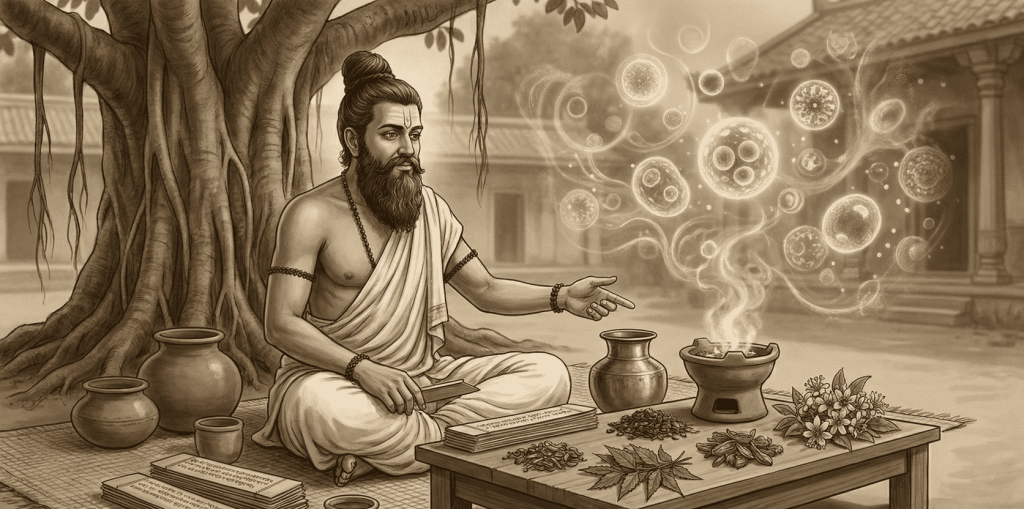
Ancient scholars like Charaka classified these organisms based on their origin and habitat in a method strikingly similar to modern clinical microbiology. They distinguished between external organisms arising from dirt that affect the skin and hair, and internal organisms residing within the body. These internal entities were further categorized by their environment, such as those born in blood, phlegm, or feces. The texts also identified specific invisible entities with pathogenic traits, using terms like Rakshas to describe parasitic behaviors and Pishacha for those that consume decaying matter. Crucially, they recognized that while some organisms could cause disease, others existed naturally within the body without causing harm, a concept akin to the modern understanding of commensal flora.
To deal with this invisible world, ancient India developed rigorous methods for sterilization and disinfection. Dhoopana, or fumigation, was a standard practice for disinfecting spaces, particularly maternity rooms and operation theaters. This involved burning specific antimicrobial herbs like Neem, Guggulu, and Vacha. Modern studies have validated this practice, showing that Dhoopana can reduce airborne bacterial counts by over sixty percent and is effective against hospital-acquired pathogens like MRSA. Similarly, the fumes from Agnihotra fire rituals, performed at sunrise and sunset, have been shown to significantly reduce the microbial load in the air and lower the virulence of pathogenic bacteria.
Specific aseptic protective measures known as Rakshoghna Karma were also applied to newborns and the wounded to prevent infection, acting as both physical and antimicrobial barriers.
Ayurveda also demonstrates an advanced grasp of microbial fermentation and biotechnology, primarily used to create stable and potent medicines known as Asava and Arishta. These polyherbal formulations are generated through self-fermentation, where the process is often initiated using the flowers of Woodfordia fruticosa (Dhataki). These flowers serve as a natural source of wild yeast species like Saccharomyces cerevisiae. The microbial consortium in these formulations facilitates biotransformation, a process where microbes extract active drug molecules that are difficult to obtain with water alone. This process breaks down complex phytochemicals into more bioavailable forms, thereby enhancing the therapeutic efficacy of the medicine.
In the realm of daily sustenance, ancient practices utilized natural antimicrobial properties to preserve food and purify water. The seeds of Strychnos potatorum, known as Nirmali, were used to clarify turbid water. Modern research confirms that these seeds act as natural coagulants that clear turbidity and significantly reduce microbial loads, including coliforms and heavy metals.
Additionally, the common practice of storing water in copper or brass pots utilizes the oligodynamic effect, where copper ions disrupt microbial cell membranes to effectively kill pathogens like E. coli.
- For food preservation, natural items like Neem leaves and Tulsi were traditionally used to prevent fungal growth and toxin production in stored grains.
Ayurveda approached gut health through the concept of the host-microbe environment rather than simply attempting to kill pathogens. The treatment principle of Prakriti Vighata involves modifying the environment of the gut to make it inhospitable for parasites. Instead of relying solely on agents to kill bacteria, this approach alters factors like gut pH and digestion strength to naturally suppress harmful microbes. The texts also identified the consumption of incompatible foods and unhygienic intake as primary causes for the proliferation of harmful internal organisms.
- Furthermore, traditional fermented foods like buttermilk were used to maintain gastrointestinal health, supporting beneficial gut flora in a manner similar to modern probiotics.
Today, this ancient wisdom offers sustainable solutions to modern challenges like Antimicrobial Resistance (AMR) and agricultural soil health. Polyherbal extracts are showing promise in restoring the efficacy of modern drugs against resistant pathogens through synergistic effects. Ancient herbal formulations are also being used in the green synthesis of silver nanoparticles that exhibit strong antimicrobial activity with lower toxicity than chemical methods.
- In agriculture, ancient liquid manures like Kunapajala, formulated from animal waste, are recognized as rich reservoirs of plant growth-promoting bacteria. These formulations recycle waste into essential nutrients and microbial biostimulants, promoting soil health without the need for synthetic fertilizers.
The Bottom Line
Modern education treats knowledge like a buffet where you only pick what you like. The Ancient Indian system was the whole meal. It understood that material prosperity and spiritual growth aren't enemies—they’re just two sides of the same coin.